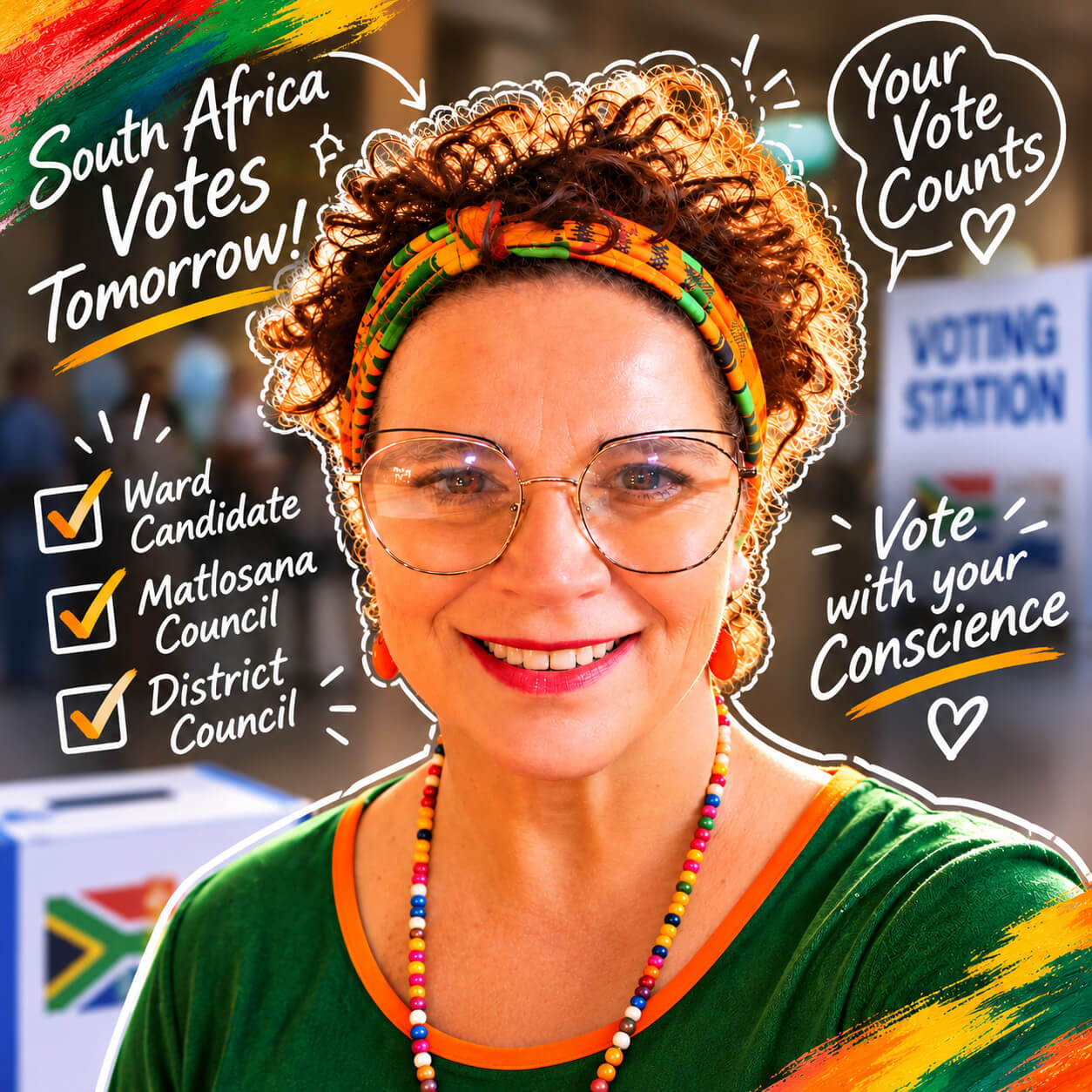
Vote with your conscience tomorrow, Klerksdorp.
On Wednesday, 4 November, we vote in the local government elections. Stations open at 07:00 and close at 21:00. Take your green barcoded ID book, smart ID card or temporary identity certificate, and vote where you are registered.
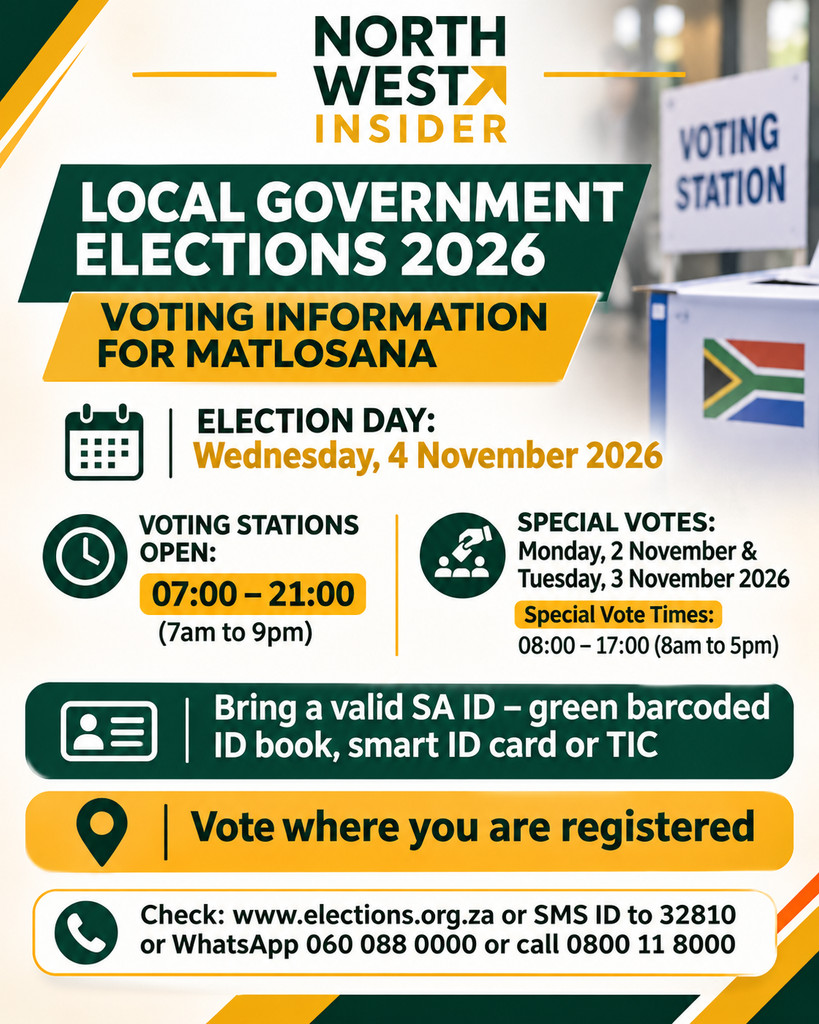
Key facts – Election Day
- Election day: Wednesday, 4 November 2026, 07:00-21:00.
- Matlosana voters receive ward, local council and district council ballots. The district is Dr Kenneth Kaunda, not North West Province.
- Councillors elect the mayor. The largest party does not automatically control a council without sufficient support.
- The Legislature reported over R11 billion in accumulated unauthorised, irregular, fruitless and wasteful expenditure for 2024/25.
- Matlosana chief financial officer Mercy Phetla was dismissed in January 2026 after a disciplinary hearing found her guilty of misconduct concerning R3.4 million in payments and a vehicle allegedly received from a service provider. This was a disciplinary finding.
First things first: tomorrow is not a national election. This ballot is not an eviction notice for the president. We are choosing our municipal representatives, not the president or the premier.
Here in Matlosana, you get three ballot papers.
One is for a person: the ward candidate you want speaking for your neighbourhood.
One is for a party on the Matlosana council.
The third is for a party on the district council, in our case Dr Kenneth Kaunda.
The district is not the province, no matter how official it sounds. Matlosana is part of Dr Kenneth Kaunda District, which is part of North West Province. Both the local and district councils are municipal government. Voters in metros receive two ballots, but here we have three.
You are also not voting directly for a mayor. The councillors choose the mayor afterwards. And the party with the most seats does not automatically take control. With more than half the seats, it has a majority. Without that, it needs support from others. Being the biggest party and being able to govern are not always the same thing.
Could these results offer an early indication of the country’s political mood? They may. But they are not a prediction of the next national election. Local candidates, local problems and who actually turns up all matter.
And here, we have a local record to consider.
Matlosana has faced repeated provincial interventions, with records documenting interventions in 2013, 2014 and a mandatory financial intervention in 2024. Whatever the differences between those interventions, needing provincial help repeatedly is hardly something to put on the town’s welcome sign.
Then there is the money.
In October 2025, the North West Legislature’s public accounts committee reported that Matlosana’s accumulated unauthorised, irregular, fruitless and wasteful expenditure had grown from a reported R6 billion in 2021/22 to over R11 billion in 2024/25.
That does not mean R11 billion was stolen. These are accounting categories covering different failures, not a theft conviction. But they are serious findings about how public money has been managed. Residents are entitled to more than a shrug and another explanation of why there isn’t money.
Separately, criminal cases involving municipal officials have reached the courts. In 2024, the Hawks reported the arrest of the municipal manager and her sister on charges including theft, fraud, corruption and money laundering. Reporting on another municipal case described allegations of payments for services not rendered and money traced to luxury vehicles.
Charges and allegations are not convictions. The courts must determine criminal responsibility. Voters, however, do not have to wait for a criminal verdict to ask political questions about oversight, leadership and accountability.
The ANC won council majorities in Matlosana in the 2011, 2016 and 2021 elections. The governing party’s record is therefore a fair subject for scrutiny. That does not make a party or every councillor personally guilty of an official’s alleged crime. It does mean those entrusted with leadership should answer for the municipality’s performance under their watch.
“There isn’t money” cannot be the beginning, middle and end of the conversation. Where did it go? What was done to protect it? What changed when the warning signs appeared? Those are not unreasonable questions. They are the questions of the people whose money it is.
This is where our vote matters.
We give representatives a voice on our behalf. We should choose people who will use it to bring change, not simply explain why change is impossible.
I want leaders who speak for the people, not simply to the people. There is a difference. A speech ends when the microphone is switched off. Representation should continue long after the chairs have been packed away.
Before you make your crosses, ask yourself: does this candidate know our ward and our daily problems? Do they listen when there is no camera? Will they ask difficult questions, follow up and tell us honestly what has been done?
Apply those questions to every party and every candidate. Nobody earns a free pass because we like their colours or have always voted for them.
Choose the person and the party you honestly believe will serve. Then keep asking questions after election day. A vote is not permission for five years of silence.
Klerksdorp deserves people who care enough to work, listen and account for their decisions. We cannot guarantee that with a cross. But we can use our crosses thoughtfully, and expect more from the people who receive them.
Vote with your conscience. Give your voice to people who will use it for you.
Maryke van Rensburg | North West Insider
Do you have a story to tell?
North West Insider shares news and stories from local people and businesses across the North West Province. Send us yours – it could be our next story.